The Biomechanical & Physiological Science of Walking Cadence
At Balanced Years Journal, walking is treated not merely as passive transportation, but as a calibrated aerobic intervention. Our methodology bridges empirical human kinetics, cardiovascular reserve modeling, and postural ergonomics.
Step Frequency and Ground Reaction Dynamics
When examining human walking mechanics, cadence—defined as steps taken per minute (SPM)—is the primary determinant of mechanical load distribution across lower extremity joints.
Sub-optimal cadences (under 95 SPM) consistently produce excessive step lengths. During overstriding, initial contact occurs significantly anterior to the body's center of mass, transforming the heel strike into a mechanical brake. This transmits high-frequency transient shockwaves upward through the ankle mortise, patellofemoral joint, and lumbar vertebrae.
Conversely, calibrating cadence into the 108–118 SPM bracket shortens stride length, promoting midfoot-to-heel contact under a slightly flexed knee. This structural geometry allows the quadriceps, gastrocnemius, and soleus to act as natural spring dampers, absorbing load muscularly rather than cartilaginously.

Zone 2 Aerobic Physiology & Heart Rate Reserve
Endurance physiology confirms that consistent low-to-moderate intensity aerobic activity stimulates mitochondrial biogenesis in Type I muscle fibers. To define this sweet spot with clinical accuracy, we employ the Karvonen model synchronized with the Tanaka maximum heart rate formula:
Heart Rate Reserve (HRR) = Max HR - Resting HR
Zone 2 Threshold = Resting HR + (0.60 to 0.70 × HRR)
Operating within this boundary ensures that oxidative phosphorylation remains the predominant energy system, promoting lipid substrate utilization while keeping blood lactate accumulation below 2.0 mmol/L. This allows individuals to train daily without incurring systemic neuroendocrine exhaustion.
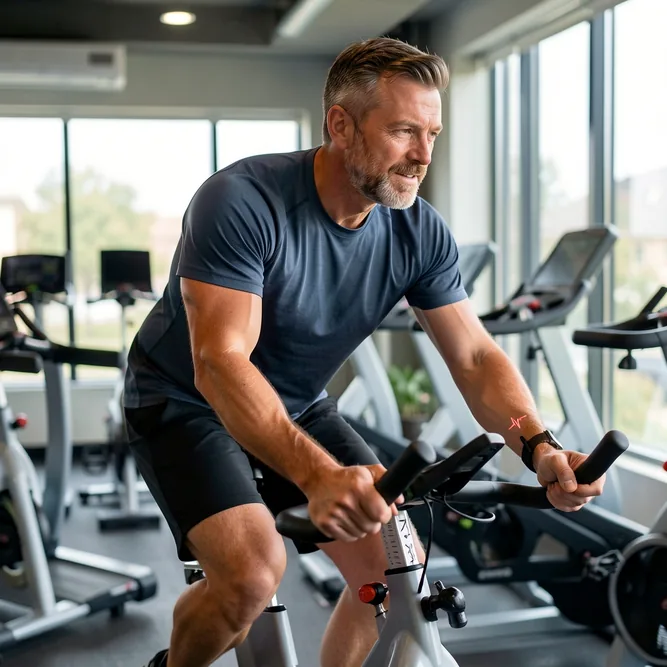
Cardiorespiratory Training Zones Overview
| Training Zone | Intensity (% HRR) | Typical Cadence | Primary Physiological Adaptation | Perceived Exertion (RPE) |
|---|---|---|---|---|
| Zone 1: Active Recovery | 50% – 60% | 80 – 95 SPM | Metabolic clearance, lymphatic flow, posture reset | 1–2 (Very Easy, effortless conversation) |
| Zone 2: Aerobic Base (Target) | 60% – 70% | 108 – 118 SPM | Mitochondrial density, fat oxidation, endurance stamina | 3–4 (Comfortably sustained, full sentences) |
| Zone 3: Aerobic Tempo | 70% – 80% | 120 – 132 SPM | Cardiorespiratory stroke volume, brisk hill climbing | 5–6 (Moderately hard, short sentences) |
| Zone 4: Threshold Pacing | 80% – 90% | 135+ SPM | Anaerobic threshold maintenance (high-tempo strides) | 7–8 (Vigorous effort, single word answers) |
Postural Alignment: The Kinetic Chain from Cervical to Calcaneal
An efficient cadence cannot be maintained on a compromised posture foundation. When the pelvis sits in excessive anterior tilt from prolonged sitting, hip extension during the terminal stance is blocked, forcing the lower back into compensating hyperextension.
- 1 Neutral Pelvic Tilt: Slight abdominal bracing establishes neutral pelvic orientation, freeing the femoral head to swing through its complete physiological arc.
- 2 Thoracic Reciprocal Rotation: Allowing the ribs and shoulders to counter-rotate with every stride unburdens the lumbosacral junction and facilitates diaphragmatic inhalation.
- 3 Forward Head Re-Alignment: Aligning ears directly over shoulder clavicles reduces cervical spinal torque by up to 25 kilograms compared to text-neck postures.
Test Your Personal Cadence Metrics
Input your age and resting pulse into our calculator to generate your individualized Zone 2 target range.
Launch Interactive Calculator